 WORLD IS ONE
Poetry · Language · Translation
Thirty languages and the journey of a poem
A poem can find new readers in another language. Choosing where it travels means thinking about the people who speak that language, its literary traditions and how the poem will be read.
An essay on language & belonging 8 min read

A poem begins in a particular language. Its tenderness may live in a form of address, its humor in the distance between a question and an answer, its grief in something the speaker leaves unsaid. A translation has to notice these things before it can carry them elsewhere.
An English adaptation might say, “Who’s in the kitchen?”—“I didn’t eat the cookies!” The setting changes, but the unasked-for denial still gives the speaker away. This is a cultural adaptation: both the room and the food have changed. In a literary work, the prayer room and bananas may need to stay. Their unfamiliarity alone is no reason to remove them.
This small example opens a larger question. When a poetry collection travels into other languages, which languages should it enter—and what should survive the journey?
Population offers a starting point
Large speaker populations can help a publisher identify where translations might find readers. Within India, twelve census language categories account for 93.28% of the population by mother tongue, using the rounded shares in the 2011 Census table reproduced by the Ministry of Home Affairs. The figure describes that census, not a new measurement of India today. Census source.
The twelve are Hindi, Bengali, Marathi, Telugu, Tamil, Gujarati, Urdu, Kannada, Odia, Malayalam, Punjabi and Assamese. The Hindi category follows the census classification, which groups several mother tongues under that heading. The statistic is useful for planning, but it does not mean a standard Hindi edition will offer every person in that category an identical reading experience.
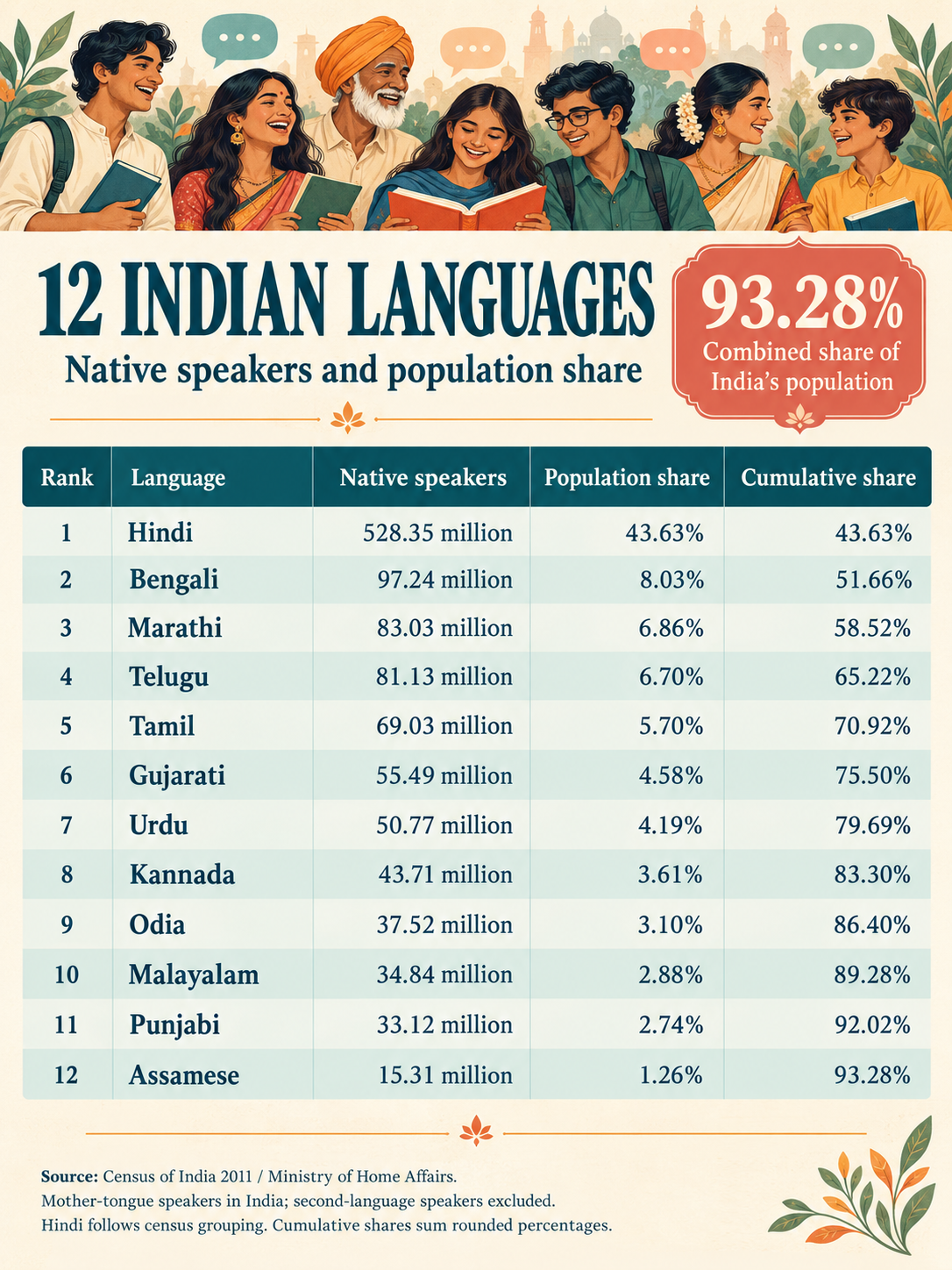
Read the India population table
| Language | Native speakers (million) | Share of India | Cumulative share |
|---|---|---|---|
| Hindi | 528.35 | 43.63% | 43.63% |
| Bengali | 97.24 | 8.03% | 51.66% |
| Marathi | 83.03 | 6.86% | 58.52% |
| Telugu | 81.13 | 6.70% | 65.22% |
| Tamil | 69.03 | 5.70% | 70.92% |
| Gujarati | 55.49 | 4.58% | 75.50% |
| Urdu | 50.77 | 4.19% | 79.69% |
| Kannada | 43.71 | 3.61% | 83.30% |
| Odia | 37.52 | 3.10% | 86.40% |
| Malayalam | 34.84 | 2.88% | 89.28% |
| Punjabi | 33.12 | 2.74% | 92.02% |
| Assamese | 15.31 | 1.26% | 93.28% |
A wider selection of literary voices
A complementary selection of eighteen other languages brings the total to thirty: Mandarin Chinese, Spanish, English, Portuguese, Russian, Japanese, Turkish, Vietnamese, Korean, Indonesian, German, French, Persian, Italian, Yoruba, Polish, Swahili and Arabic.
This is one editorial selection, not a list of the world’s thirty most important languages. Population helps explain some choices; literary variety helps explain others. A different publisher, collection or community could reasonably choose a different set.
Mandarin Chinese, Spanish and English bring large native-speaking populations. Persian and Arabic add substantial poetic traditions. Polish is a compelling choice for a poetry collection, with voices such as Czesław Miłosz and Wisława Szymborska. Yoruba and Swahili bring different African literary perspectives: Yoruba’s poetic traditions include praise poetry, while Swahili encompasses a substantial body of oral and written literature. Miłosz; Szymborska; Yoruba poetry research; Swahili literary study.
A language can add little to a population total and still bring a reader into a different literary world. Its place in the collection need not depend on the size of that number.
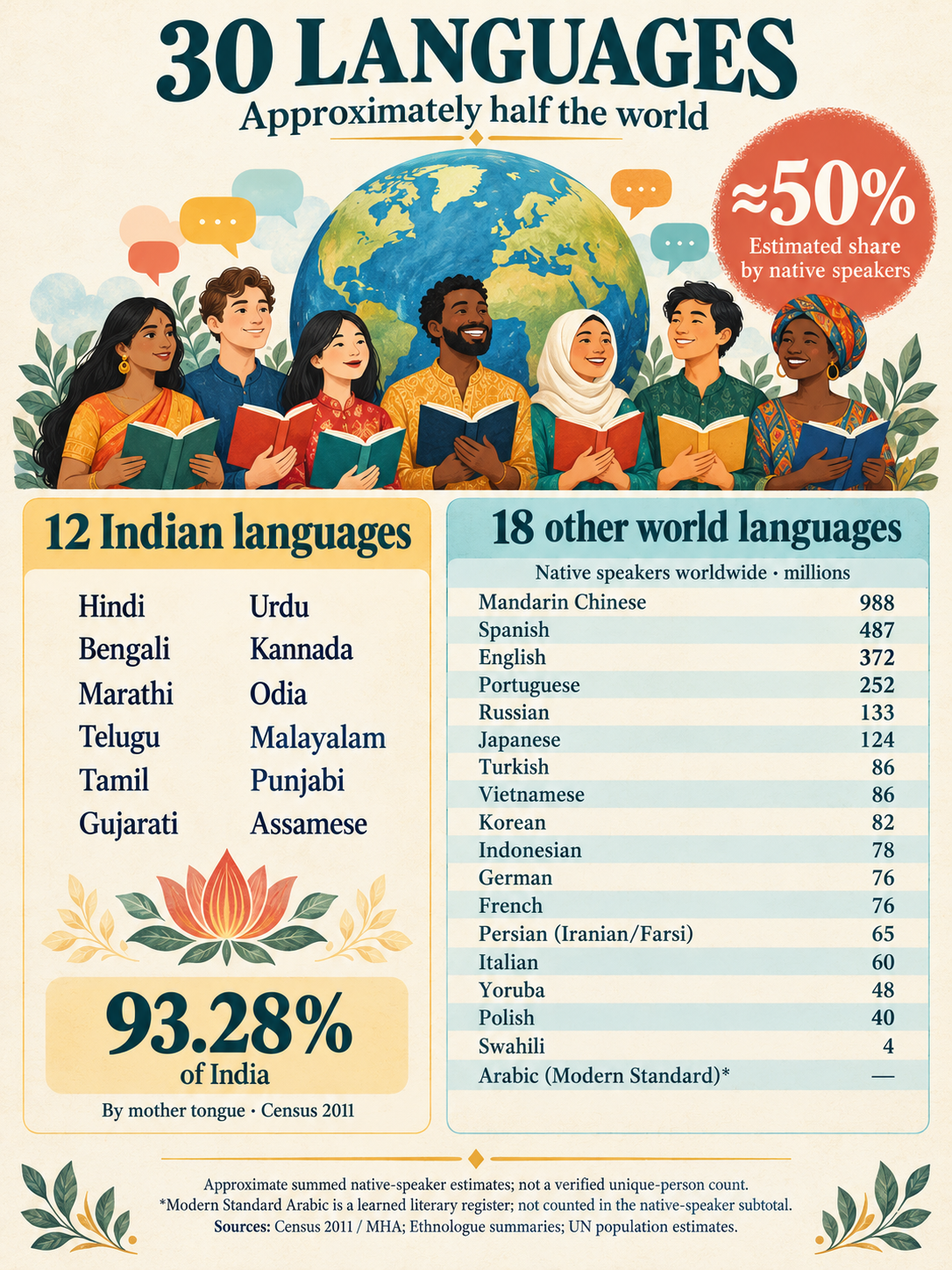
Read the worldwide population table
| Language | Native speakers (million) | Approx. world share |
|---|---|---|
| Mandarin Chinese | 988 | 11.90% |
| Spanish | 487 | 5.87% |
| English | 372 | 4.48% |
| Portuguese | 252 | 3.04% |
| Russian | 133 | 1.60% |
| Japanese | 124 | 1.49% |
| Turkish | 86 | 1.04% |
| Vietnamese | 86 | 1.04% |
| Korean | 82 | 0.99% |
| Indonesian | 78 | 0.94% |
| German | 76 | 0.92% |
| French | 76 | 0.92% |
| Persian — Iranian/Farsi | 65 | 0.78% |
| Italian | 60 | 0.72% |
| Yoruba | 48 | 0.58% |
| Polish | 40 | 0.48% |
| Swahili | 4 | 0.05% |
| Arabic — Modern Standard | Not counted | — |
Sources for the worldwide table: native-speaker summary, total-speaker summary and Polish estimate. Figures are rounded; their underlying reference years vary.
What approximately half the world means
Using rounded native-speaker estimates, this selection represents roughly half the world’s population. That phrase should be read as a planning estimate. It combines language figures with different underlying dates and definitions; a person with more than one native language may appear in more than one count. The world population benchmark used here is approximately 8.3 billion in 2026. Speaker-data summary; UN-based population benchmark.
The India table and the worldwide calculation also answer different questions. The former counts speakers within India in 2011. The latter needs worldwide figures, including speakers outside India. Those two sets of numbers should not be substituted for each other.
A speaker population is not an audience already reached. People need access to the edition, an interest in the work and the ability to read it comfortably. Even a carefully researched language estimate cannot predict how many people will encounter a particular poem.
Second languages open further doors
A second language is an additional language learned alongside or after a person’s home language. Someone may speak it confidently, read it with ease, struggle to write it, or have a different balance of abilities. There is no single reading proficiency implied by the label “second-language speaker.” The criteria used to count speakers also differ between sources. Definitions and limits of speaker counts.
This does not make second-language readers less important. Many people conduct much of their reading in a language learned through school, work or personal interest. For a poetry edition, the relevant question is whether they can appreciate the writing in that language.
Including these readers broadens potential reach, but adding language totals does not produce a valid coverage percentage. A person who reads Bengali, Hindi and English is one reader, not three. To calculate unique coverage, one would need information about which language abilities occur together in the same people.
Arabic and Swahili show the limits of counting
Modern Standard Arabic illustrates why a demographic category should not decide an editorial choice. People grow up speaking regional Arabic varieties; the standard literary register is acquired through education. Classifying it as a learned register does not put it on the same cultural footing as an unrelated foreign language. It is a significant medium for poetry and literature, even though the native-speaker subtotal used here excludes it. Arabic classification; Modern Arabic poetry.
Swahili presents a different example. The speaker-data summary used here lists about four million native speakers and ninety-one million second-language speakers. The small native-speaker number alone therefore misses much of its role as a shared language. Its oral and written literary traditions provide a separate reason to include it. The larger speaker figure still should not be presented as a count of literary readers. Swahili speaker estimates; Swahili literature.
The reader must recognize a living poem
Once the languages are chosen, the hardest decisions are still ahead. A translation has to carry what the poem says and what it leaves unsaid. The reader needs room to catch the joke. A hesitant admission should remain hesitant. A plain sentence should not become ornate simply because it has crossed a language boundary.
Natural translation also needs judgment about cultural detail. A reference can be retained, briefly explained or adapted, depending on its role in the poem. Familiarity is not always the goal. A reader can enter an unfamiliar world if the translation gives enough footing without explaining away its mystery.
For a multilingual collection, each edition should preserve the original alongside the translation where practical, distinguish translation from adaptation, and invite review from a reader fluent in the target language. Population figures can help set priorities. The quality of that encounter determines whether the poem arrives.
What people teach AI about a language
A personal reflection by Ahimanikya Satapathy
I think of AI as an intern in a company: capable, quick to contribute, and still in need of guidance. It makes mistakes. A confident answer can miss something that a person with lived experience notices immediately. Yet I believe that patient feedback can make AI a powerful creative partner, with possibilities beyond what we can imagine today.
Language is more than the rules written in a grammar book. It carries a community’s culture: how people express affection, tease one another, show respect, grieve, protest and leave things unsaid. A sentence can be grammatically correct and still feel wrong to the people whose language it is. Helping AI recognize that difference takes human experience and judgment.
This is the work I am pursuing with Odia poetry and a collection spanning thirty major world languages. When I say I am teaching the AI I work with, I mean explaining cultural context, questioning its choices, comparing versions and keeping the lessons from each correction in the translation process. Each revision is an opportunity to carry the poem’s meaning, emotional force and voice more faithfully.
My knowledge of Odia is one part of that work. Readers who live in the other languages bring knowledge I cannot supply alone. Their feedback matters: where a phrase feels unnatural, where an image loses its meaning, where the poem no longer sounds like a person speaking. That collaboration is where I see AI becoming a superpower. The ambition is thirty languages; the responsibility is to listen carefully in every one of them.
Thirty languages create thirty possible entrances. What matters beyond the number is the care with which each door is opened.
Data, sources & image notes
India figures: Census 2011, reproduced in the Ministry of Home Affairs response to Lok Sabha question 292, 16 March 2021. Worldwide figures: rounded public summaries of Ethnologue estimates, supplemented by available language-specific figures; underlying reference years vary. Shares use an approximate world population of 8.3 billion. Cumulative India shares sum rounded percentages. Population totals are indicative and may overlap; they do not establish literacy or readership. All illustrations in this article were generated with AI and reviewed against their intended editorial purpose; tabular data remain available as text.
The journey continues
A poem, finding another voice.
Explore the words, songs and conversations growing from one Odia poem.
Explore the languages